
Why Your B2B Leads Don't Convert (and How to Fix It)
If your ads bring in leads but your sales team keeps saying "these are not real buyers", the problem is rarely the ad platform. It is usually the funnel around it: where clicks land, how leads are tracked, how fast sales responds, and what you tell Google about which leads actually closed.
Here is how we fixed exactly this for a Gurugram-based newspaper advertising agency, and the order we would follow for any B2B business.
The starting point: leads, but not business
When this agency came to us in June 2026, they were already running Google Ads and getting enquiries. On paper, things looked fine. In reality:
- There was no CRM. Leads arrived by email and phone and were tracked loosely, if at all.
- Nobody could say which campaign or keyword had produced a paying client.
- Ads sent people to a general website page full of internal links, so visitors wandered off instead of enquiring.
- Google Ads was optimising for any form fill, so it kept finding more people who fill forms, not people who book ads.
This is the most common pattern we see in B2B accounts. The platform is doing what it was told. It was simply told the wrong thing.
Fix 1: Send every click to one focused landing page
The biggest single improvement came from the landing page. The old page had dozens of links pulling visitors in different directions.
We built a dedicated landing page with one job: get a serious advertiser to enquire. Everything a buyer needs sat on that one page: what they can advertise, which publications, how booking works, proof of past work, and a short form. No menu to escape through, no unrelated pages. If you need a page like this, our conversion-focused website team builds them.
A rule worth copying: if a visitor has to click away from your landing page to find an answer, you have already lost a share of them.
Fix 2: Track the source of every lead with UTM parameters
We tagged every ad with UTM parameters and captured them, along with the Google click ID (GCLID), in hidden fields on the form. Each new lead now carried its campaign, ad group, keyword and click ID.
This is what makes everything after it possible. Without source data, you cannot tell a campaign that brings buyers from one that brings time-wasters.
Fix 3: Use a Google Sheet as a simple CRM
The agency did not have a CRM, and buying one was not the first priority. So we sent every lead, with its UTM data, straight into a Google Sheet that the sales team worked from.
Each lead got a status that sales updated: new, contacted, qualified, won or lost. For many small and mid-size B2B teams, a well-structured sheet is enough to start. The tool matters far less than the habit of updating it.
Fix 4: Agree on what "qualified" means, and score every lead
Marketing and sales often disagree about lead quality because nobody wrote down what a good lead is. We agreed on two simple tests with the sales team:
- The advertiser is in a city the agency serves.
- They want to book within the next few days, not "sometime later".
Every lead was then scored as hot, warm or cold against these tests. Sales knew who to call first, and marketing had a clear definition to optimise towards.
Fix 5: Make sales faster and sharper
A good lead goes cold quickly. We mentored the sales team to call new leads fast and to ask the qualifying questions in the first conversation, so time went to real buyers.
We also set up a weekly lead quality review: marketing and sales looked at the past week's leads together, flagged junk, and spotted patterns by campaign and keyword. Those reviews fed straight into keyword and targeting changes.
Fix 6: Tell Google Ads which leads actually turned into business
This is the step most accounts skip, and the one that changes results the most.
Using the sales team's statuses in the sheet, we sent qualified leads and won deals back to Google Ads as offline conversions. We matched them using the GCLID and also used Enhanced Conversions for Leads, which matches hashed email addresses and phone numbers to the original ad click. Hashing means the personal data is encrypted before it leaves your systems.
Google's bidding then had a new target. Instead of chasing anyone who fills a form, it started looking for people who resemble the advertisers who booked. Once won deals were flowing back with values, we moved bidding to value-based bidding, so campaigns favoured the kind of clients worth the most.
The result
The quality of enquiries improved steadily, the sales team spent its time on real buyers, and the agency started winning better clients. We still work with them today.
The order matters
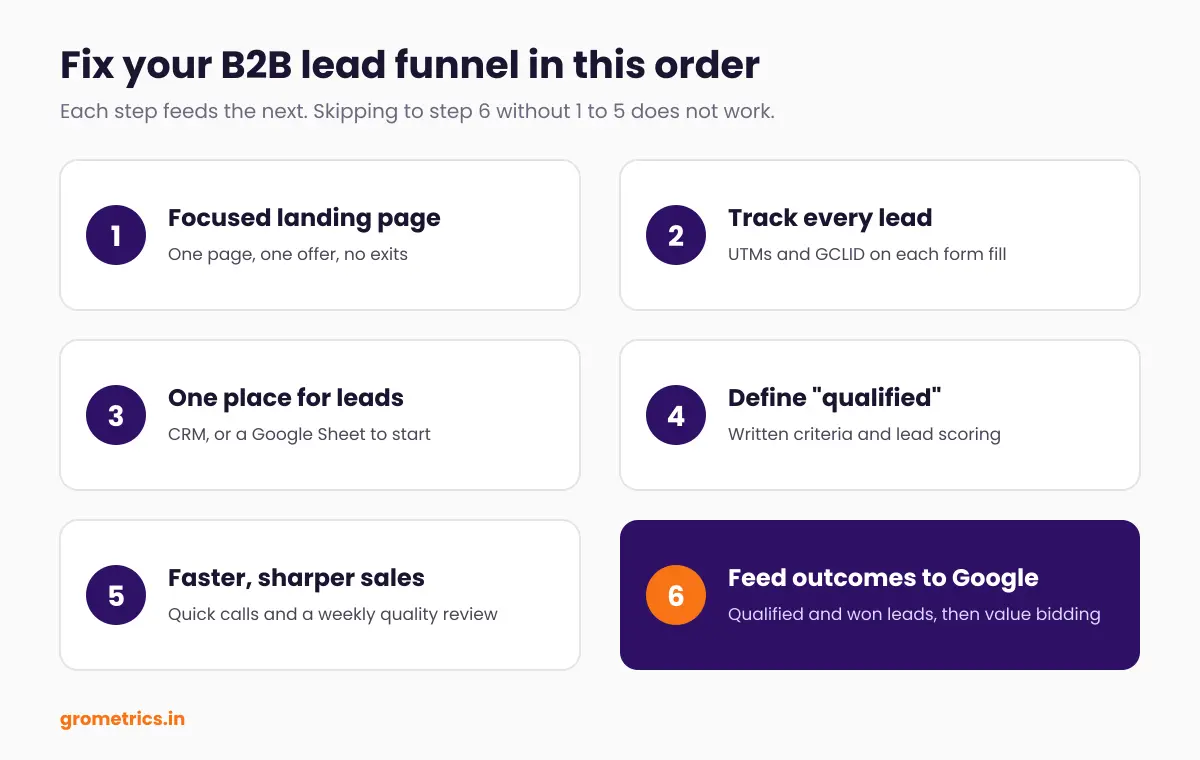
If your B2B leads are not converting, fix things in this order:
- Landing page: one focused page per offer.
- Tracking: UTMs and GCLID captured on every lead.
- A place for leads: a CRM, or a structured Google Sheet to start.
- A shared definition of qualified, with lead scoring.
- Sales speed and a weekly quality review.
- Feed outcomes back to Google Ads, then move to value-based bidding.
Skipping to step 6 without steps 1 to 5 does not work. Google can only learn from the data you give it, and that data is only as good as your tracking and your sales team's updates. This is the same process we run in our B2B lead generation service.
FAQs
Why are my B2B leads not converting into sales?
Usually because ads send traffic to an unfocused page, leads are not tracked to their source, sales follows up slowly, and the ad platform is optimising for form fills instead of qualified leads.
Do I need a CRM to fix lead quality?
No. A structured Google Sheet with lead status, source and UTM data is enough to start. Move to a CRM when volume grows.
What is offline conversion tracking in Google Ads?
It means sending the outcome of a lead, such as qualified or won, back to Google Ads after your sales team updates it. Google then optimises for leads that turn into business, not just any enquiry.
What are Enhanced Conversions for Leads?
A Google Ads feature that matches hashed email addresses and phone numbers from your leads to the original ad click, so offline outcomes can be credited even when the click ID is missing.
How long does it take to see better lead quality?
Tracking and landing page fixes show early signs within weeks. Bidding needs enough qualified and won conversions to learn from, so the bigger gains build over the following one to three months.
Is your funnel leaking good leads?
We offer a free lead quality audit for B2B companies running Google, Meta or LinkedIn ads. We review your landing pages, tracking, lead handling and what your ad platforms are optimising for, and give you a prioritised fix list.
Book your free audit
Performance marketers with 8+ years in Google, Meta and LinkedIn Ads, 250+ projects and over INR 100 crore in ad spend managed for B2B and growing brands.